Domain decomposition example using shallow water gravity wave and Dask#
This example is to demonstrate how to decompose domain and run computation on Dask’s clusters using domain split API. This notebook is based on 1_gravity_wave.ipynb, and it is recommended to familiarize with it first.
Set the grid#
[1]:
import numpy as np
import matplotlib.pyplot as plt
from  multimodemodel import StaggeredGrid

nx, ny = 100, 100
dx, dy = 1., 1.

x = np.arange(0., dx * nx, dx)
y = np.arange(0., dy * ny, dy)

c_grid = StaggeredGrid.cartesian_c_grid(x=x, y=y)
OMP: Info #273: omp_set_nested routine deprecated, please use omp_set_max_active_levels instead.
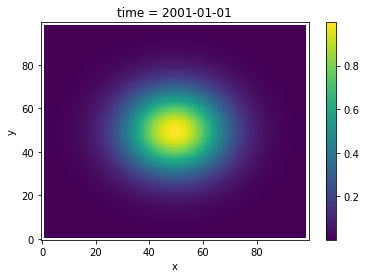
Set the initial state#
[2]:
from multimodemodel import State, Variable, str_to_date

x, y = c_grid.eta.x, c_grid.eta.y
eta = np.exp(
    -((x - x.mean()) ** 2 + (y - y.mean()) ** 2)
    / (x.max() // 5) ** 2
)

t0 = str_to_date("2001-01-01 00:00")

initial_state = State(
    u=Variable(None, c_grid.u, t0),
    v=Variable(None, c_grid.v, t0),
    eta=Variable(eta, c_grid.eta, t0)
)
initial_state.eta.as_dataarray.plot(x='x', y='y')
[2]:
<matplotlib.collections.QuadMesh at 0x19e76e160>
Define the problem to solve#
[3]:
from multimodemodel import (
    pressure_gradient_i,
    pressure_gradient_j,
    divergence_i,
    divergence_j,
    sum_states,
    Parameter,
)

params = Parameter(H=1.)

def non_rotating_swe(state, params):
    rhs = sum_states(
        (
            pressure_gradient_i(state, params),
            pressure_gradient_j(state, params),
            divergence_i(state, params),
            divergence_j(state, params)
        )
    )
    return rhs
Start up dask cluster to work on#
We want to split the domain into 4 parts and start a worker for each subdomain. Each worker will have two threads to be able to do asynchroneous communication.
[4]:
from dask.distributed import Client

# monkey patch to speed up dask client
from functools import lru_cache
import inspect
inspect.getsource = lru_cache(inspect.getsource)

parts = 4
domains_per_worker = 1
client = Client(
    n_workers=parts//domains_per_worker,
    threads_per_worker=domains_per_worker+1
)
client
[4]:
Client
Client-610ca254-a05d-11ec-b183-acde48001122
| Connection method: Cluster object | Cluster type: distributed.LocalCluster |
| Dashboard: http://127.0.0.1:8787/status |
Cluster Info
LocalCluster
a7de541b
| Dashboard: http://127.0.0.1:8787/status | Workers: 4 |
| Total threads: 8 | Total memory: 32.00 GiB |
| Status: running | Using processes: True |
Scheduler Info
Scheduler
Scheduler-6f91c279-7dca-4185-8e61-8d474420fc33
| Comm: tcp://127.0.0.1:55536 | Workers: 4 |
| Dashboard: http://127.0.0.1:8787/status | Total threads: 8 |
| Started: Just now | Total memory: 32.00 GiB |
Workers
Worker: 0
| Comm: tcp://127.0.0.1:55550 | Total threads: 2 |
| Dashboard: http://127.0.0.1:55553/status | Memory: 8.00 GiB |
| Nanny: tcp://127.0.0.1:55542 | |
| Local directory: /Users/mclaus/Documents/multimode-model/doc/examples/dask-worker-space/worker-m_7g288a | |
Worker: 1
| Comm: tcp://127.0.0.1:55548 | Total threads: 2 |
| Dashboard: http://127.0.0.1:55554/status | Memory: 8.00 GiB |
| Nanny: tcp://127.0.0.1:55541 | |
| Local directory: /Users/mclaus/Documents/multimode-model/doc/examples/dask-worker-space/worker-ttlub5gn | |
Worker: 2
| Comm: tcp://127.0.0.1:55549 | Total threads: 2 |
| Dashboard: http://127.0.0.1:55552/status | Memory: 8.00 GiB |
| Nanny: tcp://127.0.0.1:55539 | |
| Local directory: /Users/mclaus/Documents/multimode-model/doc/examples/dask-worker-space/worker-eguqu18e | |
Worker: 3
| Comm: tcp://127.0.0.1:55547 | Total threads: 2 |
| Dashboard: http://127.0.0.1:55551/status | Memory: 8.00 GiB |
| Nanny: tcp://127.0.0.1:55540 | |
| Local directory: /Users/mclaus/Documents/multimode-model/doc/examples/dask-worker-space/worker-vhje_b6h | |
Define iteration workflow#
We use the DaskWorkflow manager to distribute the computation on the previously created dask cluster.
[5]:
from multimodemodel.workflow import DaskWorkflow
from multimodemodel import (
    RegularSplitMerger,
    Domain,
    Solver,
    adams_bashforth3,
)

workflow = DaskWorkflow(
    domain=Domain(state=initial_state, parameter=params),
    solver=Solver(rhs=non_rotating_swe, ts_schema=adams_bashforth3, step=0.05),
    splitter=RegularSplitMerger(parts=parts, dim=(0,)),
    client=client
)
Perform computation#
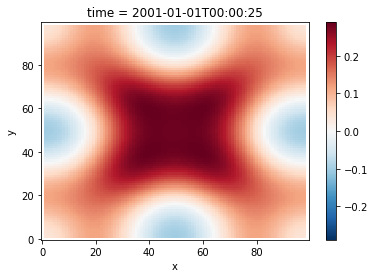
The workflow will assign a future to its domain attribute, hence the run method returns when the client has finished to compute the graph. To measure total run time, we also wait for the final result of the computation.
[6]:
%%time
workflow.run(steps=500)

# wait for the graph to be evaluated
result = workflow.domain.result()
OMP: Info #273: omp_set_nested routine deprecated, please use omp_set_max_active_levels instead.
OMP: Info #273: omp_set_nested routine deprecated, please use omp_set_max_active_levels instead.
OMP: Info #273: omp_set_nested routine deprecated, please use omp_set_max_active_levels instead.
OMP: Info #273: omp_set_nested routine deprecated, please use omp_set_max_active_levels instead.
CPU times: user 11.5 s, sys: 1.68 s, total: 13.2 s
Wall time: 19.6 s
[7]:
workflow.domain.result().state.eta.as_dataarray.plot(x='x', y='y')
[7]:
<matplotlib.collections.QuadMesh at 0x1a07f2580>
[ ]: